
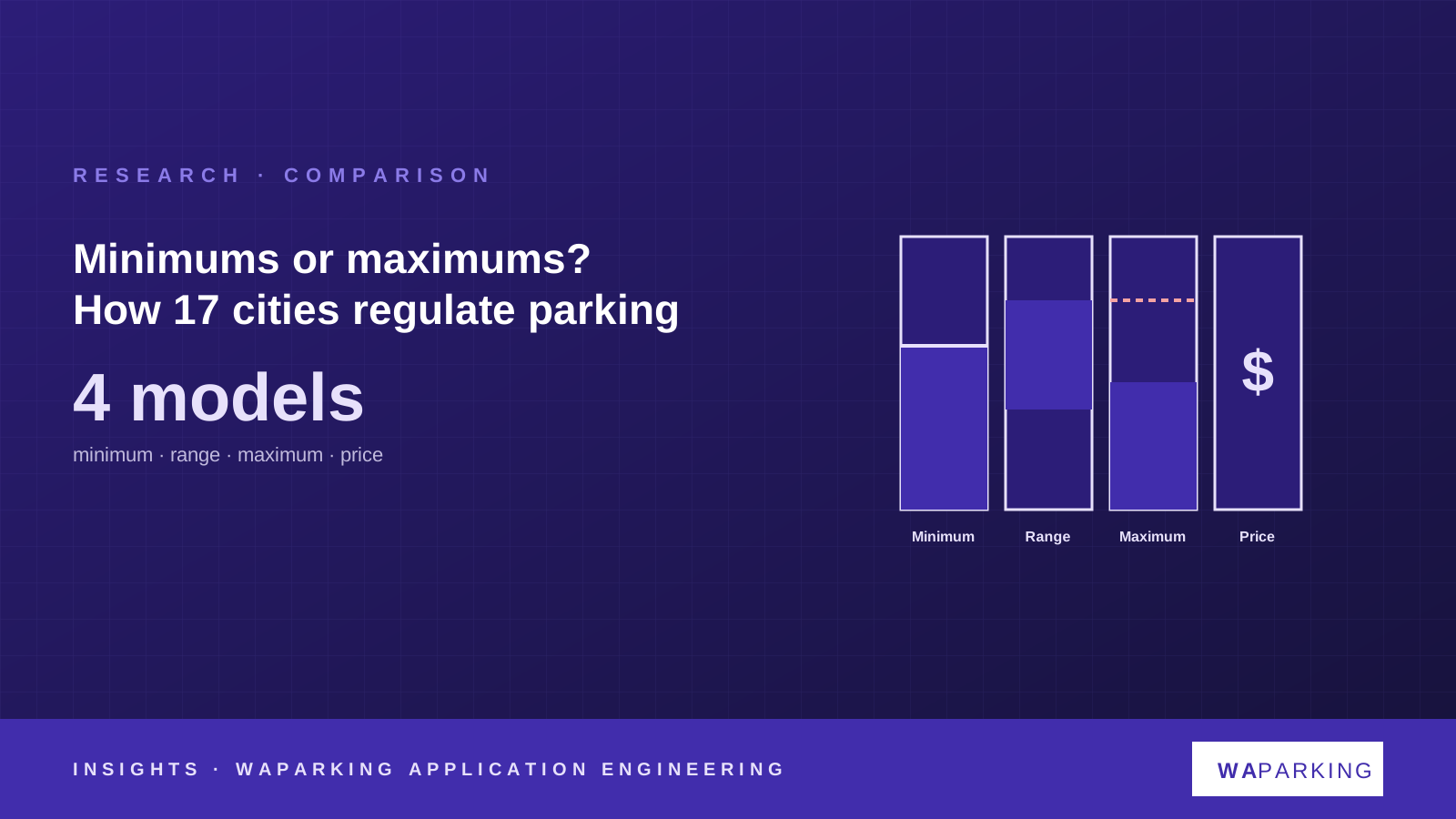
Every city in our international atlas answers one question differently: is parking an obligation, a limit, or a price?
Four models
| Model | Cities | What it means |
|---|---|---|
| Minimum | Dubai, Riyadh, Doha, Kuala Lumpur, Jakarta, Dhaka, Colombo | You must provide at least this many spaces |
| Range | Singapore | At least the lower bound, at most the upper bound |
| Maximum | London, Toronto, Sydney, central Melbourne, Madrid (non-residential) | You may provide up to this many |
| Price or none | New York (inner zone), São Paulo | No requirement; extra parking costs area or nothing is required |
Nairobi has no tenant-parking regulation yet, and Barcelona is back on its older minimums after a court annulled a reform.
Two clear trends
- Rich, transit-heavy cities cap parking. London (2004), Toronto (2022) and New York (2024) moved from minimums to maximums or no requirement, and Melbourne followed for its centre in 2025.
- Fast-growing, car-dependent cities raise minimums. Kuala Lumpur moved to two bays per new home in 2024.
Why both trends favour compact parking
Under a minimum, the developer must find room for a fixed number of cars, often more than the plot comfortably holds. Mechanical parking meets the count in less area.
Under a maximum, the developer still wants to sell as many spaces as allowed, on a site where every square metre of basement competes with plant, cycle storage and saleable space. Mechanical parking provides the permitted number in less area.
Under a range (Singapore) both pressures apply at once.
Bay size matters as much as the rule
A conventional bay plus its share of aisle and ramp takes roughly 30 sqm in Singapore or London, and around 40 sqm in the United States, where bays are 9 × 18 ft and aisles 24 ft. The larger the local bay, the more area a mechanical system recovers per car. Our Check How Many Cars Fit estimate now uses the local bay and aisle size for each country.
Browse all international parking norms.