
Jammu and Kashmir now has a single rulebook for how its cities run parking. The Housing and Urban Development Department notified the Jammu and Kashmir Parking Rules, 2026 in July 2026. The draft was published on 26 February 2026 for objections, and the notification records that none were received.
These are not building bye-laws. They do not say how many car spaces a new building must provide. They govern how municipal bodies plan, price, enforce and contract out public parking, including multi-level and stack parking. That matters to anyone who will build, supply or operate mechanical parking for a J&K city.
Where the rules apply
Rule 1 applies them to every Municipal Corporation, Municipal Council and Municipal Committee in the Union Territory, from the date of publication in the Gazette. Enforcement sits with the Municipal Commissioner and the concerned Deputy Commissioner (Rule 3). The rules work alongside the Jammu and Kashmir Parking Policy, 2025, which Rule 2 names as "the Parking Policy".
What the rules say about mechanical parking
Rule 2 defines mechanical parking as "a mechanical system to provide parking of vehicles on multiple levels". It defines multi-level parking separately, as vertical parking lots with multiple floors. Off-street parking can be open or surface, basement, multi-level, or a combination.
Rule 6 asks each municipal body to prepare Parking Area Management Plans within 6 months, in line with the Master Plan and the Parking Policy. It allows public-private partnership, through open bidding, to build surface or multi-level lots, and says a single bidder will manage each plan area.
Rule 15 covers operation and maintenance. Part A applies to every off-street lot. Part B adds conditions for stack parking sites.
Key figures in the 2026 Rules
| Requirement | Figure | Rule |
|---|---|---|
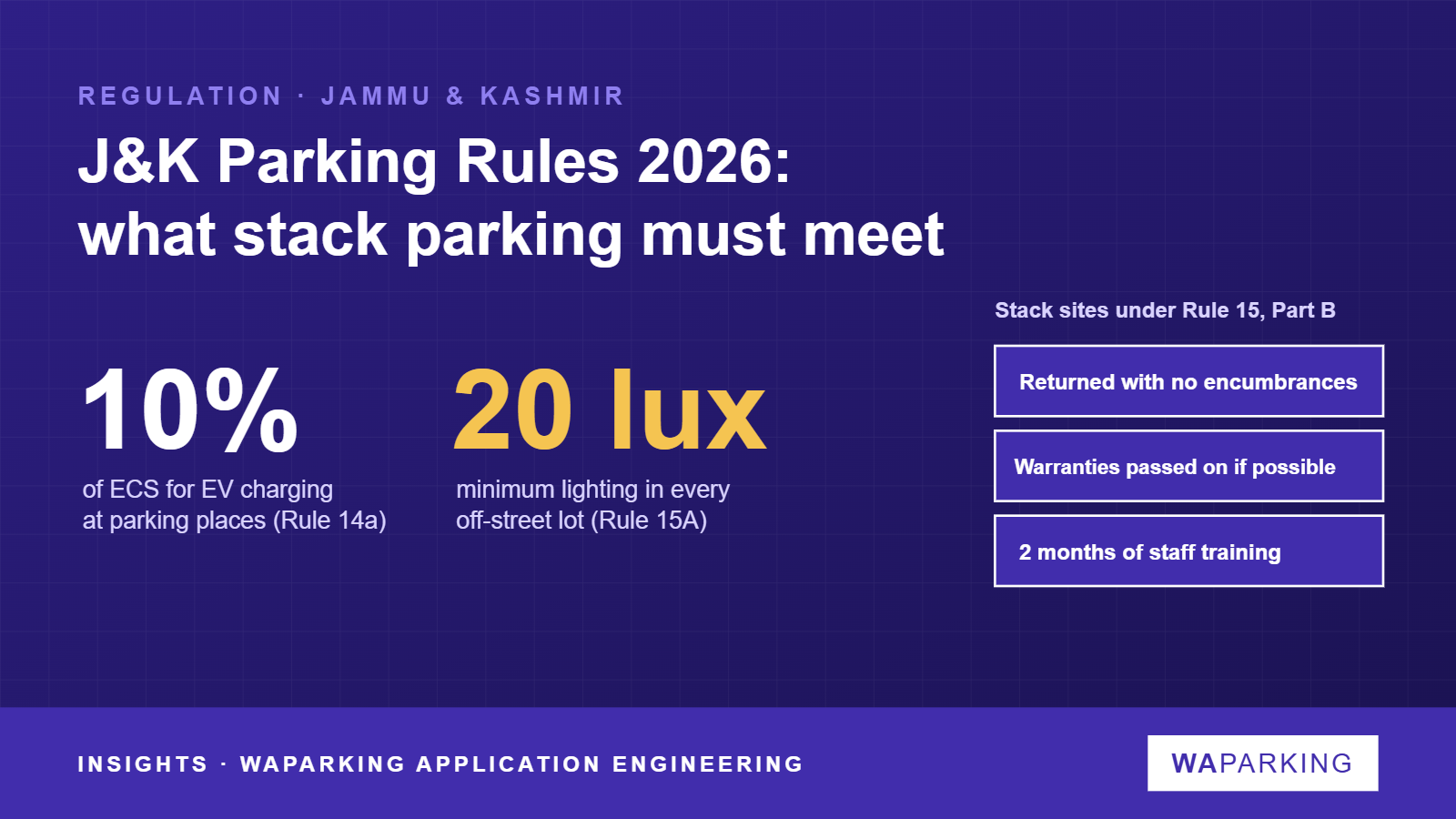
| Parking space for EV charging | At least 10% of ECS | 14(a) |
| Lighting in off-street lots | At least 20 lux at all locations | 15, Part A |
| Interval between parking signs on a block face | At least 20 m | 11 |
| Time to prepare Parking Area Management Plans | 6 months | 6 |
| Staff training before a stack site is handed back | 2 months before transfer | 15, Part B |
| Force majeure period after which a contract can end | 30 days | 19 |
The rules do not fix any fee, fine or licence rate. Those are left to the Parking Committee or the Municipal Commissioner.
Part A: what every off-street lot must provide
Under Rule 15 Part A, the service provider must keep the following working round the clock:
- illuminated entry and exit points;
- toilets and drinking water;
- functional fire-fighting and public address systems;
- generator backup and protection against waterlogging;
- lighting of at least 20 lux everywhere in the lot.
The provider also pays the utility charges and insures the site. Parking sensors and CCTV are optional here. Rule 9, however, allows enforcement through CCTV cameras that read number plates.
Part B: stack parking sites are handed back
For stack parking, Part B adds three conditions. At the end of the contract, or on termination if earlier, the provider must transfer the facility to the municipal body or its nominee "free and clear of any encumbrances". Live guarantees, warranties and insurance policies transfer where possible. In the 2 months before transfer, the provider trains municipal staff to run the facility.
Payments, data and EV charging
Every fee and fine must be cashless (Rule 7). Integration with the National Common Mobility Card is mandatory. Collections go to an escrow account (Rule 8). The Authority runs a control centre at the city's ICCC that receives real-time data on each parking event: plate, vehicle type, times, fees and fines (Rule 12).
Rule 14(a) requires at least 10% of the ECS in a parking place to be provided for EV charging. Rule 14 also brings in licences for private commercial parking near stations and hospitals. Rule 16 lets private owners open land for public parking against a per-sq-m licence fee set by the Parking Committee.
What this means for a mechanical parking design
- Design for handover from day one. A stack site goes back to the city at contract end. Drawings, manuals, spares lists and maintenance records should be complete enough for municipal staff to take over. Warranties should be assignable.
- Plan the power load early. Generator backup is mandatory, and 10% of spaces must serve EV charging. On a stack or puzzle system, decide early which pallets get charging and where the cables run.
- Put the controls on the city's network. Cashless payment, NCMC and real-time data to the ICCC mean the system controller and gates need an open interface to the city's parking management software.
- Light and drain the pit. The 20 lux minimum and the waterlogging rule apply to pits and lower levels as much as to open lots.
Caveats and what to confirm
- Our copy is a scanned gazette notification from the J&K Law Department portal. Some text is garbled, including the notification number and exact date. The EV figure prints as "10o/o", which we read as 10%. Confirm against a clean gazette copy before relying on it in a bid.
- The rules leave fees, fines and licence rates to each Parking Committee. Check the local order before pricing a project.
- Building parking requirements still come from the applicable building bye-laws and master plans, which these rules do not change.