
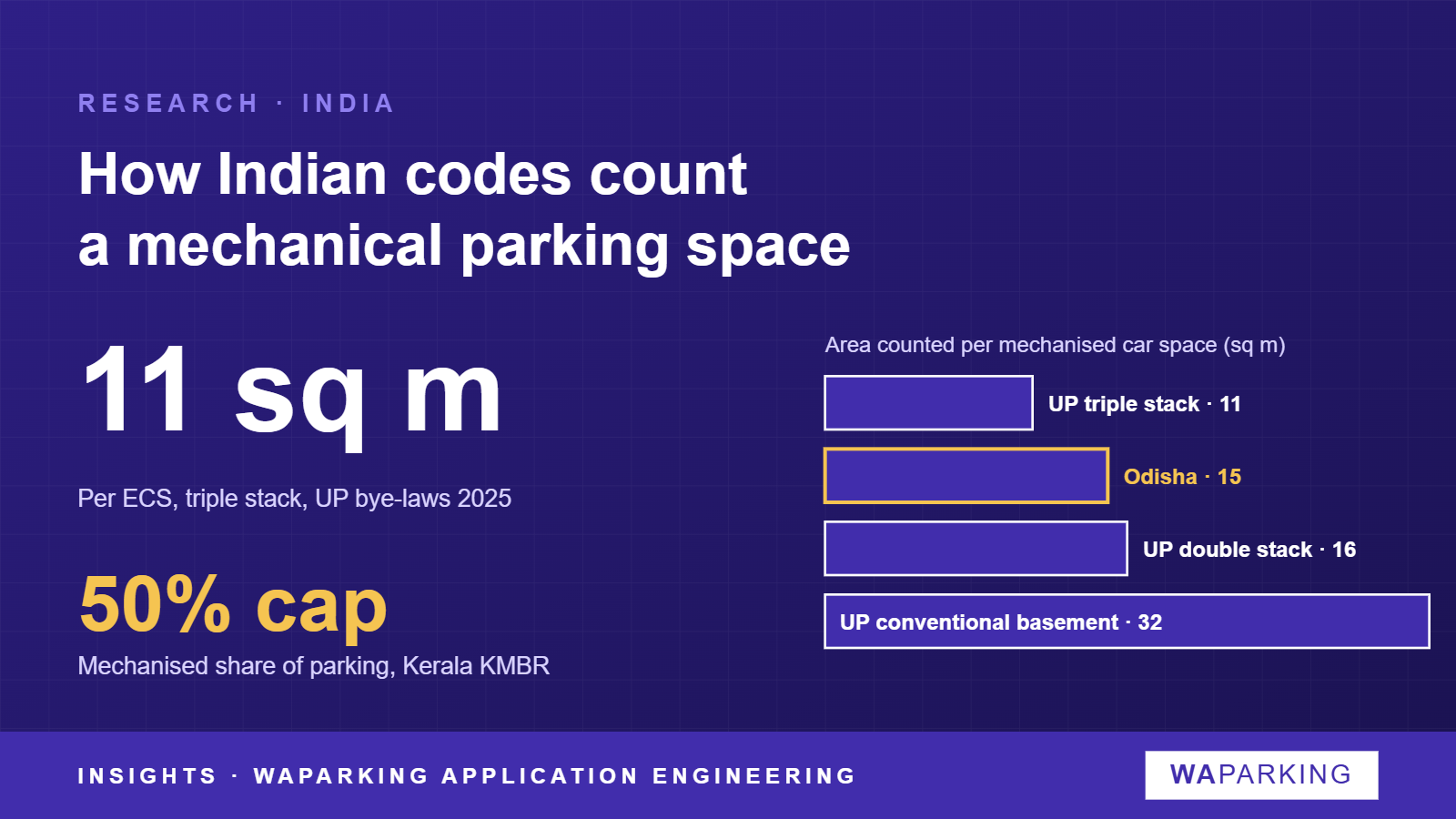
Every Indian building code tells you how many cars a building must park. Fewer tell you what a mechanical space is worth. On a stack, a puzzle or an automated system, that second question often decides the design. It sets how much floor a system must occupy, and whether a stacked car counts at all.
We have read the parking chapters of nine codes for this series. They answer the question in four different ways.
Four ways to count a stacked car
| Approach | Code | Clause | What it says |
|---|---|---|---|
| Fixed area per mechanised ECS | UP model bye-laws 2025 (Lucknow, Ghaziabad) | Byelaw 3.3.4.1 | 16 sq m per ECS for double stacking, 11 sq m for triple stacking, "or as per actual design" |
| Fixed area per mechanised ECS | ODA Rules 2020 (Bhubaneswar) | Rule 37 | 15 sq m per ECS in stacked, multi-level or automated parking |
| Area multiplier | CGDCR 2017 (Ahmedabad) | Notes to Table 6.44 | Area used for stacked parking counted at 1.5 times |
| Minimum mechanised bay | UDCPR 2020 (Pune, Nagpur) | Reg. 8.1.1(ii), Note 1(b) | 2.3 × 5.8 m for a big car, 2.1 × 5.0 m for a small car |
| Cap on the mechanised share | KMBR, as amended 2025 (Kochi) | Rule 29(10), Rule 2 | At most 50% of mandatory car parking; both cars of a twin stack count as mechanised |
| Silent | MP Bhumi Vikas Rules 2012 (Indore) | Rules 95(5), 96(2) | Area divisors only: 35 sq m per car in a basement |
| Silent | AP Building Rules 2017 (Visakhapatnam) | Rule 6(30), Table 11 | Parking set as a share of built-up area |
| Silent | GLDBCR 2010 (Goa) | Reg. 2(126), 10(f) | Mechanical device or car lift allowed for access; no counting rule |
| Silent | CBR (Urban) 2017 (Chandigarh) | Rule 4.2 | No clause on mechanical parking found |
Area credits: UP, Odisha and Gujarat
Three codes turn a stacked car into a smaller area. UP is the most explicit. Byelaw 3.3.4.1 lists the area per ECS for each type: 23 sq m open, 28 sq m covered, 32 sq m basement, 16 sq m for a double stack and 11 sq m for a triple stack. Twenty cars in a conventional basement take 640 sq m on paper. The same twenty in a double stack take 320 sq m.
Odisha sets parking as a share of built-up area, then counts a mechanised ECS at 15 sq m. An apartment block with 8,000 sq m of built-up area needs 30%, or 2,400 sq m. Fully mechanical, that is 160 ECS.
Gujarat works the other way. The parking requirement is an area, and stacked parking area is counted at 1.5 times. A 2,000 sq m requirement can be met with about 1,333 sq m of stacked parking. The credit is the same for a two-level stack and a taller one.
Bay size: Maharashtra
UDCPR does not discount mechanised parking. It counts cars, and Note 1(b) to Regulation 8.1.1(ii) sets the smallest pallet that counts as one: 2.3 × 5.8 m for a big car and 2.1 × 5.0 m for a small car. A conventional bay is 2.5 × 5.0 m. The mechanised bay is narrower but longer, so the pallet size on the supplier's data sheet decides compliance.
A cap: Kerala
Kerala allows mechanised parking but limits it. Under Rule 29(10), "fifty per cent at the maximum" of the mandatory car parking may be mechanised. The Rule 2 definition adds that in a twin unit, "both cars parked shall be considered under the mechanised parking category". A two-level stack uses two places of the allowance, not one.
Codes that are silent
Indore, Visakhapatnam, Goa and Chandigarh say nothing on how a stacked car counts. Madhya Pradesh divides floor area by a fixed figure, for example 35 sq m per car in a basement. Andhra Pradesh asks for a share of built-up area, 20% for apartments in a municipal corporation. Goa allows stilts reached "by adequate ramps and/or mechanical device" and a car lift where a ramp is not feasible. None of them sets a rule for a car parked above another.
What this means for a mechanical parking design
Find the counting rule before the layout. Where a code gives an area per mechanised ECS, the system's density turns straight into fewer square metres. Where it caps the share, as in Kerala, half the cars must still be conventional.
Check the pallet against the code, not the brochure. In Maharashtra a pallet narrower than 2.3 m does not count as a big-car bay.
More levels do not always earn more. Gujarat's 1.5 times credit is fixed. UP gives triple stacks a smaller area (11 sq m) than double stacks (16 sq m), so the third level earns its own credit.
Where the code is silent, get it in writing. In Indore, Visakhapatnam, Goa or Chandigarh, ask the sanctioning authority how each pallet will be counted before the drawings are fixed.
Caveats
- This is a comparison of the clauses we have read. Each code has more conditions on height, fire safety and setbacks; see the city articles in this series.
- UP's figures allow "as per actual design", so an authority may accept other areas.
- The UP row covers the development authorities (Lucknow, Ghaziabad). NOIDA, Greater Noida and YEIDA now follow the separate Model Building Regulations, 2026 issued to UP's industrial development authorities in October 2026; see our article on those rules.
- Codes change. The Kerala rules were amended again in August 2026, and we have not yet read the official text of that amendment.
- Delhi, Mumbai, Bengaluru, Hyderabad and Kolkata are not in this table. We will add them once each counting rule is read at source.
Related reading
- Primary source: Kerala Municipality Building (Amendment) Rules, 2025, G.O.(P) No. 53/2025/LSGD (Local Self Government Department, Government of Kerala, 2025)
- Delhi parking under UBBL 2016: 16 sq m per stacked car
- Kochi parking under KMBR 2025: the 50% mechanised cap
- Ahmedabad: parking as a share of FSI and a 1.5× stack credit
- Check your city's parking norms in the Compliance Atlas