
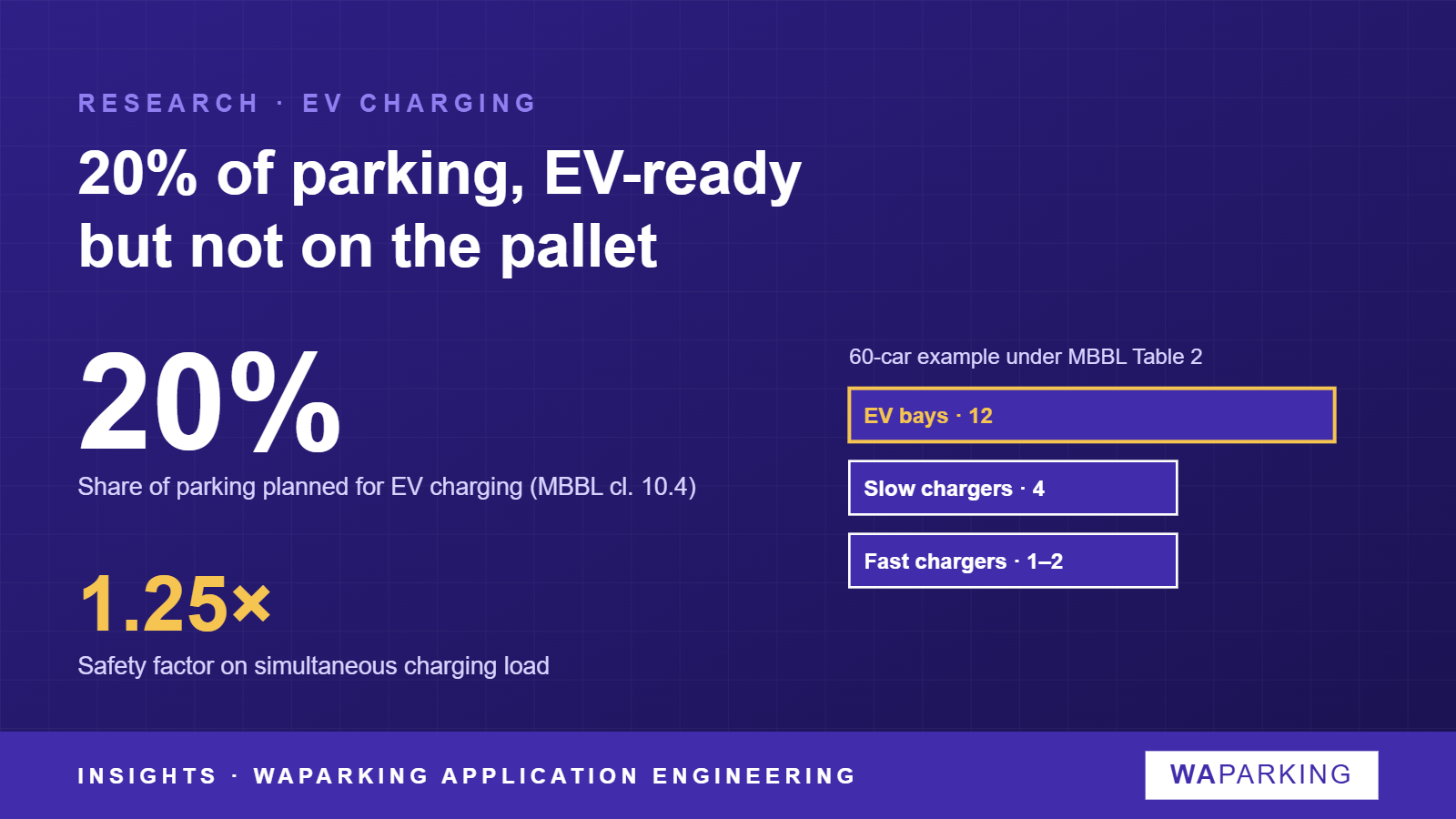
There is no single national EV charging code for buildings. The reference text is MoHUA's 2019 amendment to the Model Building Bye-Laws 2016 (MBBL), which states and city authorities adopt into their own regulations. The one number that matters is in clause 10.4: charging provision is planned on 20% of the parking capacity of the premise. The Ministry of Power's 2024 guidelines then decide how those chargers are connected and billed, and state fire services decide where they may physically sit. For mechanical parking, that last layer is the one that bites.
What the model bye-laws require
Clause 10.4 of the amended MBBL applies charging infrastructure to EVs, "currently assumed to be 20% of all 'vehicle holding capacity'/'parking capacity' at the premise". The explanatory note says the 20% is a starting assumption for metro and Tier I cities, to be revised as EV share grows.
The same clause sizes the electrical side. The premise must have additional power load equal to all charging points operating at the same time, with a safety factor of 1.25.
Plotted houses (clause 10.4.1, Table 1) need at least one slow charger. All other buildings, including group housing (clause 10.4.2), follow Table 2, which sets charger ratios for charging run as a public charging station (PCS).
| Vehicle type | Slow chargers (SC) | Fast chargers (FC) |
|---|---|---|
| Four-wheelers (cars) | 1 per 3 EVs | 1 per 10 EVs |
| Three-wheelers | 1 per 2 EVs | - |
| Two-wheelers | 1 per 2 EVs | - |
| Buses (PV) | - | 1 per 10 EVs |
| Charging bays to plan | 20% of all vehicles, including 2Ws and cars |
Source: MBBL 2016 (amended 2019), cl. 10.4, cl. 10.4.2 and Table 2 with note.
The Table 2 notes also ask for open metering and on-spot payment for all users. Battery swapping is optional.
What the Ministry of Power adds
The MoP Guidelines for Installation and Operation of EV Charging Infrastructure-2024 (dated 17 September 2024) do not repeat the 20% figure. Annexure II simply asks offices, commercial buildings and RWAs to set aside the share "specified in the building bye-laws of the state".
Three provisions matter for housing. Under clause 16(2), a society can set up a common charging station. Under clause 16(5), "Residents can install private EV charging stations in their designated parking spaces", on their own meter or a sub-meter. Under clause 15(4), domestic tariff applies to home charging. Chargers must meet the BIS standards in Annexure I (clause 6(1)), and a fire department NOC is needed for a charger in a basement (Annexure III(B), item 8).
A worked example
Take a group housing project with 60 flats and, as an assumption for this example, 60 car parking spaces.
- EV charging bays at 20%: 60 × 0.20 = 12 bays.
- If all 12 are cars and the facility is run as a PCS under Table 2: 12 ÷ 3 = 4 slow chargers, plus fast chargers at 1 per 10 EVs (1.2, so one or two depending on how the local authority rounds; the MBBL is silent).
- Sanctioned load: the combined rating of every charging point running together, multiplied by 1.25.
The bye-law sets the count. It does not say which 12 spaces. That choice is the design problem.
The Maharashtra fire position
The Directorate of Maharashtra Fire Service circular MFS/51/2024/1140 (18 July 2024) sets fire guidelines for parking structures under UDCPR-2020. Its Annexure A says the Directorate is aware of automated parking makers adding in-system charging and "discourage[s] such charging system in the mechanized car parking system". It then states: "as of now, no Electric Vehicle charging point/station shall be allowed in the Automated car parking tower, Puzzle car parking and basement car parking."
The same annexure (General, item 1(i)) says charging "shall not be provided in basement / on upper levels of automated car parking facility". The circular's hazard list notes that EVs inside a car stacker "require particular and specific design consideration". The reasoning given is lithium-ion thermal runaway: long fires, re-ignition and the limits of installed firefighting systems.
What this means for a mechanical parking design
The pallet is the bay, but it is not the charging bay. In Maharashtra, the 12 EV bays in the example cannot be puzzle or automated positions. Plan them as open, ventilated surface spaces from the first layout.
Count the 20% against the right base. Clause 10.4 uses total parking capacity. If mechanical systems supply most of the parking, the 20% still has to fit in the conventional spaces that remain. Check this before fixing the mechanical share.
Private chargers meet a hard wall. MoP clause 16(5) lets a resident fit a charger in their designated space. Where that space is a puzzle or stack pallet in Maharashtra, the fire circular does not allow it. Allotment should give EV owners a surface bay, or the society should plan a common station under clause 16(2).
Outside Maharashtra, treat charging on moving pallets as an engineering question, not a default. A charger feeding a pallet that travels needs a flexible cable carrier or a contact at a fixed parking position, interlocked with pallet movement. Each adds failure points and must be approved by the local fire authority.
Size the electrical room once. The 1.25 factor applies to the whole charging load. Provide it at sanction, even if chargers are installed in phases.
Caveats and what is pending
- The MBBL is a model. Only the version notified by your state or city authority is binding; check the local DCR for its own percentage.
- The MBBL does not say how fractional charger counts are rounded.
- The Maharashtra circular says "as of now", so the ban on charging in automated, puzzle and basement parking may be revised.
- Other states' fire services may take a different view. Ask for their written position before committing to charging inside any mechanical system.
Related reading
- Primary source: Amendments in Model Building Bye-Laws (MBBL-2016) for Electric Vehicle Charging Infrastructure (with URDPFI 2014 amendments) (Ministry of Housing and Urban Affairs (copy hosted by the Ministry of Power), 2019)
- Maharashtra's 2024 fire circular and mechanical parking
- What NBC 2016 Says About Fire Safety in Car Parks
- Stack, puzzle or tower: which system fits which plot
- Check your city's parking norms in the Compliance Atlas