
Thane and Navi Mumbai both build under Maharashtra's Unified Development Control and Promotion Regulations (UDCPR), notified in December 2020. But the parking rules a designer meets in each city are not in the same state. Here is what we could confirm at official sources.
Which rules apply where
UDCPR Regulation 1.1(i) applies the regulations to all Planning Authorities and Regional Plan areas in Maharashtra. It then lists the exceptions: the Municipal Corporation of Greater Mumbai and authorities within its limits, MIDC, NAINA, Jawaharlal Nehru Port Trust, hill station councils, notified eco-sensitive zones and Lonavala.
Thane Municipal Corporation is not on that list. Neither is Navi Mumbai Municipal Corporation (NMMC), nor CIDCO's Navi Mumbai area. So UDCPR applies in both cities. The one CIDCO area that the 2020 text leaves out is NAINA, the notified area around the new airport. A plot there follows NAINA's own regulations, not UDCPR.
The Bombay High Court also treated UDCPR as applying to NMMC. In PIL No. 123 of 2016, the petition challenged UDCPR's off-street parking rules (Regulations 8.1 to 8.2.2) as applied in NMMC's area.
How the city factor works
UDCPR sets base parking ratios in Table 8B. A multiplying factor for each class of planning authority sits in Table 8C, under Regulation 8.2.2.
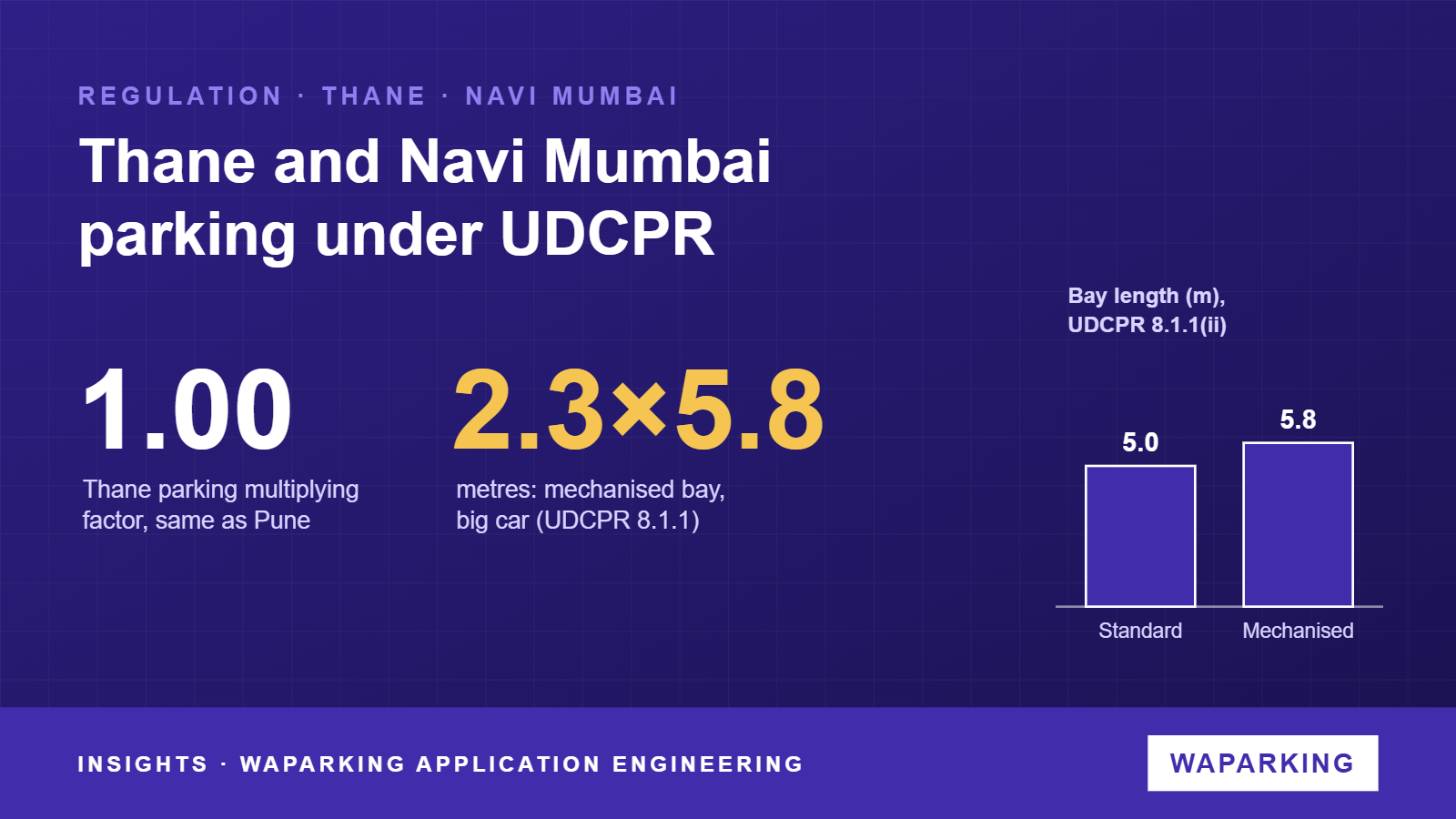
For Thane, the Maharashtra Fire Services circular of 18 July 2024 is explicit. It says that "for various cities, different multiplying factors are there but cities like Thane, Pune etc. it is 1.00." In practice, a Thane project takes the Table 8B car figures without reduction, as Pune does.
The same circular adds a point that is easy to miss. Table 8B and 8C parking should be planned for the plot's full permissible potential, even if the first permission covers only part of it.
Navi Mumbai: same code, ratios under review
Navi Mumbai's parking ratios are contested. In 2016 the High Court made an interim order: each tenement up to 45 sq m built-up (35 sq m carpet) had to get at least one parking space. In its judgment of 22 December 2023, the court found that the State and NMMC had not weighed its earlier directions when framing UDCPR. It directed NMMC to set up an expert committee, report within four months, and finish the amendment process under Section 37 of the MRTP Act within 12 months.
Lokmat Times (news, secondary source) reported in January 2025 that NMMC had announced stricter residential norms, awaiting State approval. We did not find a notified amendment at an official source. Until one is, ask NMMC for its current practice.
Key figures
| Item | Figure | Source clause |
|---|---|---|
| Thane multiplying factor | 1.00 | MFS circular 18.07.2024, para 3 (on Table 8C) |
| Standard car space | 2.5 × 5.0 m | UDCPR 8.1.1(ii) |
| Smaller car spaces allowed | up to 50% at 2.3 × 4.5 m | UDCPR 8.1.1(ii), Note 1(a) |
| Mechanised bay, big car | 2.3 × 5.8 m | UDCPR 8.1.1(ii), Note 1(b) |
| Mechanised bay, small car | 2.1 × 5.0 m | UDCPR 8.1.1(ii), Note 1(b) |
| Stilt height | not less than 2.4 m to beam bottom | UDCPR 8.1.1(i) |
| Stilt height for stack parking | up to 4.5 m | UDCPR 8.1.1(i) |
| Car drive width | 3.0 m minimum | UDCPR 8.1.1(iv) |
| Mechanical parking in side/rear margin | at 1.5 m, with 6.0 m clear drive | MFS circular, para 4 |
| Standalone steel parking tower height | not above 100 m | MFS circular, para 11 |
The mechanised bay sizes were inserted by Corrigendum/Addendum No. CR 79/2021 of 2 December 2021.
What this means for a mechanical parking design
- In Thane, size the car count from Table 8B at a factor of 1.00. Do not assume an MMR reduction.
- In Navi Mumbai, confirm the governing body first: NMMC, CIDCO or NAINA. Then confirm whether any stricter NMMC ratio is in force.
- Use the 2.3 × 5.8 m and 2.1 × 5.0 m bay sizes for mechanised or puzzle systems. Check the system's pallet against these, not against the 2.5 × 5.0 m conventional space.
- If a tower or stack goes in a side or rear margin, keep it 1.5 m from the boundary and keep a 6.0 m drive clear for fire appliances.
- The fire circular also requires 2-hour fire separation between an attached tower and the building, and it does not permit EV charging points in automated towers or puzzle parking. Plan EV charging elsewhere.
Caveats and what to confirm
- We could not read Tables 8B and 8C in full at an official source. The table above leaves out the base ratios and every factor except Thane's.
- The fire circular says Table 8B needs one car per tenement of more than 30 up to 40 sq m carpet, plus 5% visitors. Check this against Table 8B itself before relying on it.
- Pimpri-Chinchwad's factor is not covered here because we could not verify it at source.
- UDCPR has been amended several times since 2020. Use the latest consolidated text and the city-specific provisions in Chapter 10.
- Confirm the parking count and layout with the planning authority and fire department before final design.
Related reading
- Primary source: Unified Development Control and Promotion Regulations for Maharashtra State (consolidated) (Urban Development Department, Govt of Maharashtra (copy hosted by MMRDA), 2023)
- Nagpur parking under UDCPR: the 0.9 factor and stack rules
- Mumbai's 25% visitor parking rule and redevelopment norms
- Pune TOD zones: where the 50% parking cut really applies
- Check your city's parking norms in the Compliance Atlas