
Same region, different code
Gurugram and Faridabad are part of Delhi NCR, but they are in Haryana, and Delhi's bye-laws stop at the border. Building plans there are sanctioned under the Haryana Building Code 2017 — whether the site is a DTCP-licensed colony, an HSVP sector or a municipal area. Our article on Delhi's ECS rules does not apply to a project in Gurugram.
The unit is still the Equivalent Car Space (ECS). What changes is how the requirement is set, how the ECS is converted to floor area, and what the code says about mechanical parking.
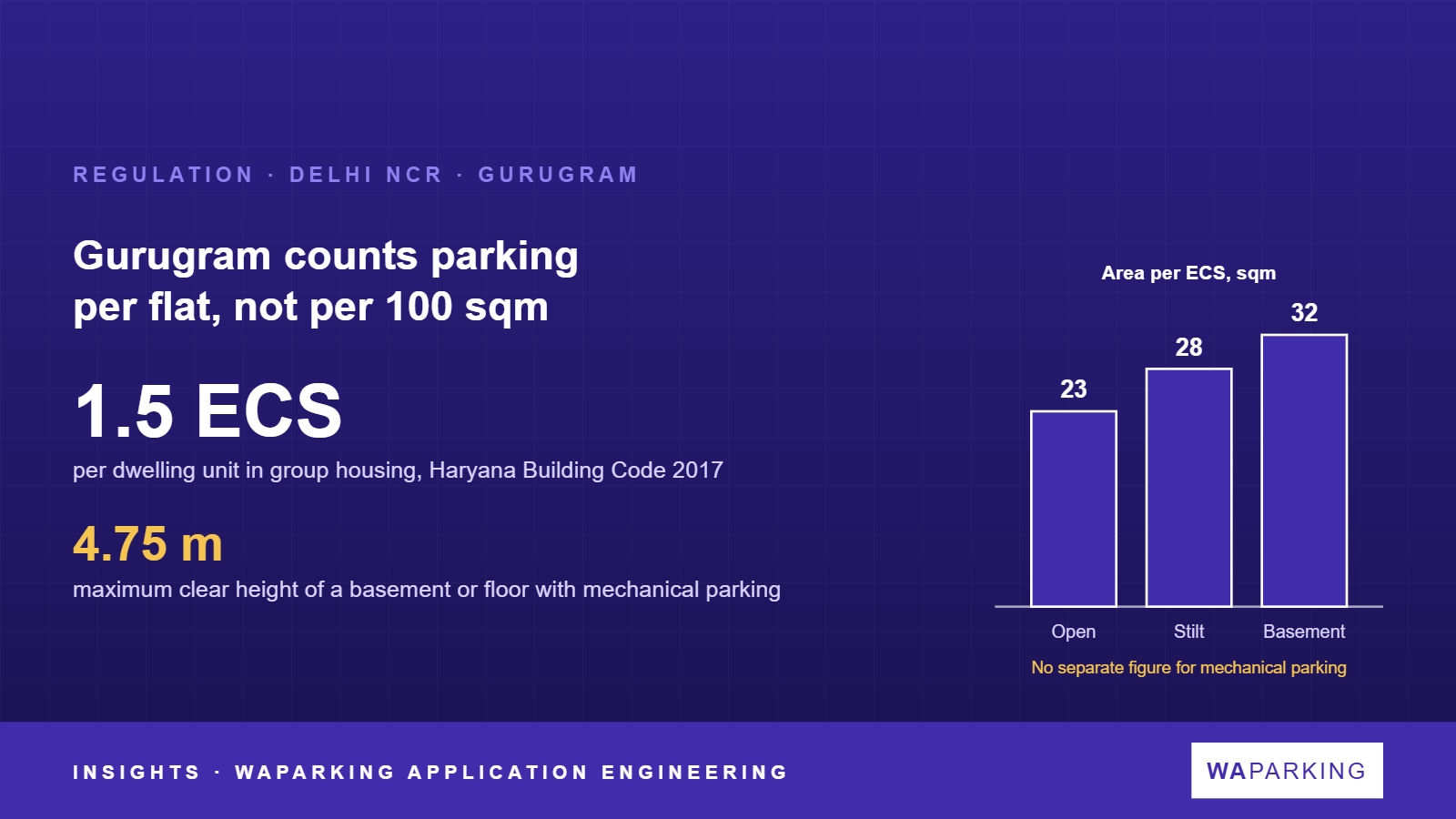
The requirement is per flat, not per 100 sqm
Delhi sets parking per 100 sqm of floor area. Haryana sets residential parking per dwelling unit. Code 7.1 of the Haryana Building Code 2017 reads, in substance:
| Use | Parking required |
|---|---|
| Plotted colony | 1.5 ECS per dwelling unit |
| Group housing | 1.5 ECS per dwelling unit, with at least 5% of the total parking area made available to EWS flats |
| Multi-storey commercial, big box retail, shopping mall | 1.0 ECS per 50 sqm of covered area |
| Offices, Cyber Park, IT Park, Cyber City | 1.0 ECS per 40 sqm of covered area |
| Hospital | 1.0 ECS per 2 beds, plus 1 ECS per 4 beds for visitors |
A per-flat rule treats a 60 sqm one-bedroom and a 250 sqm four-bedroom alike. Against the 2 ECS per 100 sqm commonly applied to group housing in Delhi, the two rules meet at 75 sqm per flat. Below that size Haryana asks for more parking, and above it less. Schemes of compact flats are where Gurugram basements run short.
How an ECS becomes floor area
For sites other than residential plots, the code converts each ECS to area:
| Where the car is parked | Area per ECS |
|---|---|
| Open | 23 sqm |
| Stilt | 28 sqm |
| Basement | 32 sqm |
The figures match Delhi's for open, stilt and basement parking. The difference is the row Haryana does not have. Delhi's bye-laws count stacked or automated parking at 16 sqm per ECS. The Haryana code gives no separate figure for mechanical parking.
What the code does say about mechanical parking
Three clauses in Code 7.1 shape a mechanical scheme:
- Covered parking is outside FAR. Parking in a basement, a stilt or a multi-level structure above ground does not count towards Floor Area Ratio. A separate parking block's footprint does count towards ground coverage.
- A 4.75 m height cap. Where mechanical parking is provided in a basement or on upper floors, the floor-to-ceiling clear height may be up to 4.75 m. This permits the extra height a stacker needs. It is also a limit.
- No storage or shops in parking. Commercial use or storage in covered parking is not allowed, and misuse attracts three times the composition fee for excess covered area.
What the 4.75 m cap means for system choice
A two-level stacker needs about 3.6 m clear, and a two-level puzzle 3.6 to 3.8 m. Both fit under 4.75 m with margin for services. A third level above the floor usually does not. On a Haryana project, a three-level system generally means a pit below the parking floor, which has to be designed into the basement slab from the start.
Fix the system before the structural design freezes the slab and beam levels. Our headroom article gives the clearances by system type.
Ask how a stacked car is counted
The code expects mechanical parking, since it sets a height for it. But it does not say how many ECS a stacked or puzzle space is worth. Before relying on stacked spaces to meet 1.5 ECS per flat:
- Show the mechanical layout, with each car position numbered, on the parking plan submitted for sanction.
- Ask the sanctioning authority (DTCP, HSVP or the municipal corporation) to confirm that each mechanically parked car counts as one ECS.
- Propose an independent system (puzzle or tower) for visitor and EWS parking, so any car can leave without another being moved. Keep dependent stackers for allotted bays.
- Keep the written confirmation in the sanction file.
EV charging from June 2026
In June 2026 Haryana amended the building code to require EV charging in new buildings with parking for ten or more vehicles. Residential buildings need one charging point for every five parking spaces, and commercial buildings one for every three. Charging may be placed in basement and stilt parking.
Mechanical systems can carry charging on the pallet, but the fire consultant should approve this at concept stage. Treat it as a fire-safety decision, not a fit-out item.
Noida and Ghaziabad
Noida and Greater Noida, across the Yamuna, follow their own building regulations, and Ghaziabad follows Uttar Pradesh's bye-laws. Neither uses the Haryana code. We will cover them separately once we have read the parking tables in the regulations themselves.